1 Introduction
Leadership has been a major topic of research in psychology for almost acentury (Zaccaro & Klimoski,2001). Such research, especially prominent in theorganizational and social psychology literatures, tends to focus on theinterpersonal processes between individuals, nominally leaders and followers.However,leadership primarily focused on the nature of the relationship betweenthe leader and the follower (Zaccaro & al?,2001),because it is widely regarded asone of the key factors for success in the organizational context (Yukl, 2010).While, the last two decades have witnessed something of an explosion ofinterest on the role of leadership and management in empowering followers andproviding them felling of autonomy support in organizations. Commenting on histhoughts about leadership. Bill Gates once said,"As we look ahead into the nextcentury, leaders will be those who empower others." This statement seems to bepredicting what seems to be the future structure of organizations. Nowadays,leaders face the challenges of empowering and motivating followers as a primaryneed. Twenty first century leaders' most precious resource is human resource. It isthe only source to ensure sustainable organizational harmony in the environmentof fierce competition,and multiple challenges facing organizations (Stone, Deci,& Ryan, 2009). Recent research has indicated that leadership is one of the factorsthat affect deeply employees' autonomy at work (Gagne & Bhave, 2011).Leadership, as a process,is both an art and science of motivating followers byproviding support and help, promoting creative performance, enhancingorganizational trust and well being, weakening the turnovers intention,stimulatingsignificant positive behaviors among followers and facilitating psychologicalempowerment to provide followers the felling of autonomy and self-determinationin order to act effectively.
Although we know a lot about leadership and about motivation, littleempirical work has examined the effects of leadership on follower's motivation inhuman resource management and organizational behavior field, and because weknow little about the psychological motivators involved in the process of effectiveleadership,such research is warranted.Previous research materials has explored perceived organizational support,perceived supervisor support,and emphasized the relationship betweensupervisors' and employees' benefits on the basis of Social Exchange Theory(SET). Research has studied the influence of perceived organizational support andperceived supervisor support on employee's autonomy support and carried out theframework of support-reward, which is a kind of extrinsic motivation. In this process the employee was passive and controlled. This kind of empowermentmechanism is completely different from the new trend in the research ofmotivation where Deci and Ryan's self-determination theory has provided arigorous empirical evidence to explain a comprehensive understanding of theirtheory as a result of integration of many motivation theories. Self-determinationtheory researchers consider autonomy support as innate and come from the self; itis one kind of intrinsic motivation. Also, all behaviors driven by rewards aresupposed to increase the employees' extrinsic motivation.
………..
2 Literature Review
2.1 Effective Leadership Brief Review
Leadership is widely regarded as one of the key factors forsuccessfullorganizations (Yukl,2010). Most durable definitions tend to viewleadership as primarily a social process that takes place in-group context wherethe leader influences followers (both directly and through the design of theorganizational context) to behave in a certain manner so as to achieveorganizational goals (Munshi, Oke,& Puranam, 2005). Leadership is alsodescribed as "the ability of a superior to influence the behavior of subordinatesand persuade them to follow a particular course of action". (Barnard 1938). Bass(1990) suggested that leadership was the ability to influence those you are leadingtowards the achievement of goals and objectives.Zaccaro et al. (2001) demonstrate that leadership is the most important inputfactor on team effectiveness. In addition, effective leadership is firstly focusing onthe nature of the relationship between the leader and the follower. In other words,leadership is relational, not primarily organizational, or corporate. In its mostbasic definition,a leader is someone who has a follower; it is a relationshipbetween at least two people. One of the assumptions is that the two roles areinseparable; one cannot be a leader without a follower, and, therefore,a followermust have a leader too. Though inseparable,they are not simply mirror images ofeach other. That is, one cannot simply define leadership or, by implication, assumethat followership is clearly defined. Thus,effective leadership is concerned withthe people being led not with tasks being accomplished.
………
2.2 Autonomy-Supportive Leadership Behavior Contents
In this literature,focus is mainly concentrating on the concept of autonomysupport, because according to our research it provides the framework forunderstanding how autonomy supportive leaders can be effective and supportfollowers without undermining their locus of causality. Autonomy involves actingwith a sense of volition and having the experience of choice. In the words ofpsychologists, autonomy represents an inner endorsement of one's actions~thesense that one's actions emanate from oneself and are one's own (Deci& Ryan,1987). It is the capacity to have one's motivation emerge from internally locusedand volitional sources of motivation rather than from an externally locused (e.g.,external regulation) or a non-volitional (e.g.,introjected regulation) causality(Deci& Ryan, 1985; Reeve, Nix,& Hamm,2003).The concept of autonomy,as conceptualized by Self-determination theoryresearchers, in relationship to the development of human resources has receivedlittle empirical attention. According to Self-determination theory (SDT),ifmanagers facilitate, rather than undermine,the critical managing dimensions ofautonomy support, involvement,and structure, then follower will develop aspsychologically healthy. In addition, SDT would also predict that based on thesecritical managing dimensions,follower will develop differential innermotivational orientations known as general causality orientations (GCO) (i.e.,autonomy, control,and impersonal) representing varying degrees of autonomy(i.e., self- determined behavior),which in turn should predict psychologicaldistress or health.
……….
3 Research Questions and Design.......... 23
3.1 Research Existing Questions......... 23
3.1.1 Autonomy-Supportive Leadership Research Shortage......... 23
3.1.2 The Mediating Mechanisms......... 23
3.1.3 Control Variables Setting......... 24
3.2 Research Overall Design......... 24
4 Study 1: Autonomy-Supportive Leadership Behavior Contents......... 28
4.1 Research Purpose......... 28
4.2 Research Method .........28
4.3 Leadership Behavior Contents Interview Research.........28
4.4 Leadership Behavior Contents QuestionnaireSurvey Research......... 33
4.4.1 Questionnaire Process......... 33
4.4.2 Survey Results......... 34
5 Study 2: Autonomy-Supportive Leadership Behavior Effectiveness.........36
5.1 Research Objectives and Hypothesis......... 36
5.2 Research Method......... 37
5.3 Research Results......... 41
7 Research Conclusion and Discussion
7.1 The Core Viewpoint
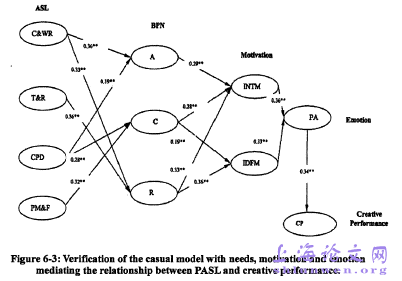
In the context of China corporate culture characteristics, autonomysupportiveness aspects that are mainly reflected from leaders are; Counseling andwork recognition,Trust and respect. Instructing employees' career planning, andPositive monitoring and feedback. Chinese corporate managers and leadersprovide through these four important aspects support to their employees, as welllet them acquire strong perceived autonomy support.The empirical study survey has shown that managers provide autonomysupport to employees,but employees' perception of autonomy support can beaffected because of their individual causality orientations differences. Although,Employees that acquire higher autonomy orientation can be more actively gottenthe provided environmental information, and have stronger perception ofautonomy support than those employees with controlled orientation. Moreover, itdoes not exist a significant moderating role of autonomy-oriented employees onautonomy supportive leaders' behaviors and employees' creative performance.By enhancing leaders' perceived autonomy support behavior, employeespromote autonomous motivation level,and enhance creative performance. Theempirical study has shown that higher autonomy support perception stimulatehigher autonomous motivation, resulting in better creative performance.
……….
Conclusion
First of all,this research introduces the idea of autonomy support leadershipin the Chinese corporate organizational background to explore thenatureofautonomy support in China. Research mostly studies the role of autonomysupportin medicine and education fields. Only few empirical studies in theorganizational background have studied the effects of autonomy support; thetheoretical research on autonomy support in management is considered as newtopic that needs more consideration. The existing research was made on the basisof "the social exchange theory", and the relevant empirical research lacks. In thisstudy we utilized a motivational theory called self-determination theory. Theexisting body of research on leadership effect on creative performance gave moreimportance to leaders traits and behaviors, which is our starting point. But,research focused on investigating the role of leadership unilaterally and ignoredthe intermediary mechanism of impact of leadership on creative performance. Thefindings of the present research drew a real picture about the relationship betweenleadership and creative performance.Moreover, this study investigated the behaviors of autonomy-supportiveleaders within the organizational context. Secondly, it investigated the effect ofleaders ‘ behavior on employees perceived autonomy support,autonomousmotivation as mediating variables,and individual differences as a moderatingvariable. It adopted self-determination theory principles and verified the pathmodel of the mechanism of impact of autonomy-supportive leadership behaviors.Thirdly,this research verified the path model of the effect of perceivedautonomy-supportive leadership on employees' basic psychological needs(autonomy, competence,and relatedness), employees' motivation,and emotions.The results showed that this pathway was a very good explanation to enhanceorganizational creative performance.#p#分页标题#e#
…………
References (omitted)

