英语论文哪里有?本研究结果表明任务重复对高英语水平学生口语输出准确性有积极影响,主要表现在词汇准确性和结构准确性的提升上。任务重复对低英语水平学生的口语输出准确性也起积极作用,主要表现在词汇和语法准确性的提升上。
Chapter One Introduction
1.3 Framework of the Thesis
On the whole, this thesis has the five chapters.
In Chapter 1, the background of this research, purposes of this research, and the significances of this research are introduced. In Chapter 2, task repetition and the accuracy of oral output are given sufficient attention, and a detailed literature review is carried out from the aspects of definition and previous studies. In addition, the second chapter also mentions the theoretical basis of the thesis, such as Trade-off Effects, and Levelt’s Speech Production Model. The third chapter focuses on the research process, clarifying the selection of research objects, data collection methods, data analysis methods and so on. Chapter Four discusses and analyzes the collected data. In Chapter 5, the main results and limitations of this study are presented. In addition, this chapter deals with recommendations for future research. The five chapters mentioned above constitute the main part of this thesis.
Chapter Three Methodology
3.1 Research Questions
In this study, task repetition was the concern of research, and two groups of high school students at high or low English level were the main participants to explore the effects of task repetition on oral English output accuracy of students at high English level and students at low English level. In general, this study tried to find answers to the following three questions through tests and interview:
1. Does task repetition influence the oral English output accuracy of senior high school students at high or low English level?
2. If so, what are the effects?
3. What are high-level and low-level students’ understanding of task repetition and oral English output accuracy, and their views on the relationship between task repetition and oral English output accuracy after the tests?

Chapter Four Results and Discussion
4.1 Results and Discussion of the Tests
The discussion and the tests mainly focused on the impact of task repetition on the accuracy of oral English output of senior high school students at high or low English level. The collected data are classified and analyzed in four aspects: lexical accuracy, phonetic accuracy, grammatical accuracy and structural accuracy.
4.1.1 Lexical Accuracy
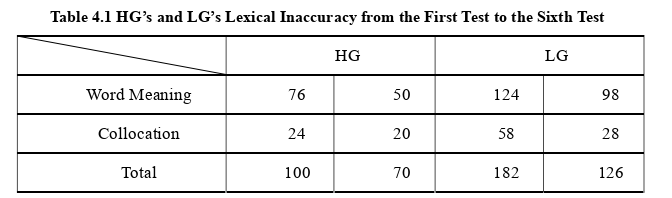
The measurement of lexical accuracy mainly focused on two aspects such as word meaning and collocation (James, 2001; Llach, 2011). In general, the performance of the two groups of students with high or low English level had improved to some extent after six rounds of task, and the specific data were shown in Table 4.1.
4.2 Results and Discussions of the Interviews
In order to obtain both high-level and low-level students’ and both novice English teachers’ and experienced English teachers’ understanding of and views on task repetition, oral English output accuracy and the relationship between task repetition and oral English output accuracy after the tests, this study conducted interviews with them. Based on the interview results, the author tried to find answer to the third research question.
4.2.1 Students’ and Teachers’ Understanding of Task Repetition and Oral English Output Accuracy
In this part, both high-level and low-level students’ and English teachers’ understanding of task repetition, oral English output accuracy and the relationship between task repetition and oral English output accuracy were summarized.
Chapter Five Conclusion
5.1 Major Findings
Starting from task repetition, this study discussed its effects on the oral English output of high-level and low-level students in lexical accuracy, phonetic accuracy, grammatical accuracy and structural accuracy through interviews and tests. In addition, the study also studied high-level students and low-level students’ understanding of task repetition and oral English output accuracy, and their views on the relationship between them.
Firstly, the results of the tests showed that task repetition had effects on the oral English output accuracy of both high-level students and low-level students on the whole. More specifically, task repetition had nothing to do with the grammatical accuracy and phonetic accuracy of students at high English level, but had something to do with their structural accuracy and lexical accuracy. Meanwhile, task repetition had nothing to do with the phonetic accuracy and structural accuracy of students at low English level, but had something to do with their grammatical accuracy and lexical accuracy.
Secondly, the results showed that for students at high English level, task repetition had a positive effect on their lexical accuracy and structural accuracy, but had no effect on their grammatical and phonetic accuracy. Specifically, the improvement of high-level group’s lexical accuracy was reflected in word meaning instead of collocation. Besides, the improvement of high-level’s group’s structural accuracy was reflected in conjunctions instead of pronouns. For students at low English level, task repetition had a positive impact on their lexical accuracy and grammatical accuracy, but had no impact on their structural accuracy and phonetic accuracy. Specifically, the improvement of low-level students’ lexical accuracy was reflected in pronouns instead of collocations. It was worth mentioning that task repetition had little effect on the phonetic accuracy of both groups of students.
reference(omitted)

