电子商务论文哪里有?本研究采用混合法的研究方式,将定量数据分析与摩洛哥电子商务生态系统中关键利益相关者(包括政府官员、企业主和IT专业人员)的访谈所得的定性见解相结合。
1 INTRODUCTION
1.2 Statement of the Problem
While the positive correlation between robust network infrastructure and e-commercegrowth is well-documented,the dynamics of this relationship in the context of emergingmarkets like Morocco are less understood.The complexities of building and maintaining adigital infrastructure capable of supporting the demands of cross-border e-commerce in anemerging market context present a unique set of challenges and opportunities.These includebut are not limited to,issues related to internet penetration rates,the reliability and speed ofconnectivity,digital payment systems,and the regulatory frameworks governing onlinetransactions.Moreover,the socio-economic impacts of e-commerce on traditional marketsand the broader implications for Morocco's economic development strategy warrant a detailedinvestigation.This study aims to dissect these multifaceted dynamics,offering a nuancedunderstanding of the role of network infrastructure in enabling cross-border e-commerce inMorocco.

3 OVERVIEW OF NETWORK INFRASTRUCTURE AND CROSS-BORDER E-COMMERCE IN MOROCCO
3.1 Historical Overview and Preface
The rise of digital economies worldwide has fundamentally changed the wayinternational trade works,with network infrastructure playing a central role in determining thelandscape of cross-border online commerce.Situated at the intersection of Africa and Europe,Morocco has acknowledged the profound impact of digitization and is actively undertaking astrategic initiative to strengthen its digital infrastructure.This initiative is focused on not onlypromoting local economic expansion but also establishing a distinct position for Morocco inthe worldwide digital economy,namely in the field of international online commerce.
In the late 1990s,Morocco initiated a focused endeavor to enhance its networkinfrastructure.This was prompted by the worldwide trend towards digitalization and thecountry's aspirations to establish itself as a prominent digital economy in Africa.The creationof the National Telecommunication Regulatory Agency(ANRT)in 1998 marked thebeginning of the liberalization of the telecom sector,paving the way for further progress.During this time,key programs such as Maroc Numeric 2013 and Digital Morocco 2020 wereimplemented.
These projects aimed to improve broadband access,promote competition in thetelecommunications sector,and enhance digital literacy among the population.
5 RESEARCH RESULTS AND INTERPRETATION
5.1 Analysis of Quantitative Data
This section delves deeply into the quantitative analysis to understand the impact ofnetwork infrastructure on e-commerce in Morocco.the comprehensive dataset,derived from amix of governmental reports,e-commerce platforms,and consumer surveys,provides a robustfoundation for this exploration.
5.1.1 Descriptive Statistics
the initial focus on descriptive statistics reveals a detailed picture of the current state ofinternet infrastructure across Morocco and its correlation with e-commerce metrics.
Internet Speed and E-commerce Metrics Across Regions:-Urban Areas:Exhibit average internet speeds of 25 Mbps.Monthly e-commercetransactions in these areas reach approximately 15,000,with customer satisfaction ratingsaveraging 4.2 on a 5-point scale.
-Semi-Urban Areas:Show decreased internet speeds averaging at 15 Mbps.Theseareas see around 8,000 e-commerce transactions monthly,with customer satisfaction ratingsdropping to 3.8.
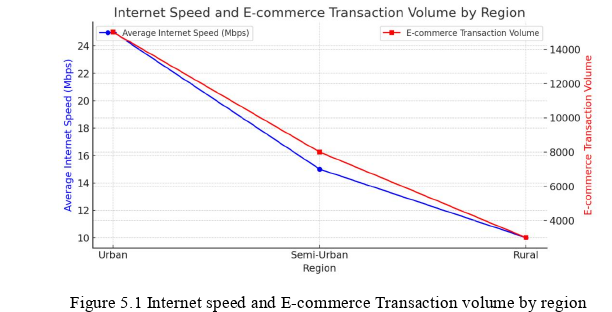
5.2 Overview of Collected Data
As the stage is set for the empirical analysis of internet infrastructure and its effects on e-commerce activity in Morocco,the compiled data from various sources provides acomprehensive view of the digital landscape up to early 2023.
(1)Internet Penetration and Mobile Usage:
In 2023,Morocco demonstrated a robust internet penetration rate of 88.1%,showcasinga significant increase in digital connectivity across the population.By 2024,this rate isexpected to reach 90.7%,indicative of a steady upward trend in the adoption of Internetservices.
Moreover,the country's mobile market reflects a penetration rate that surpasses the totalpopulation,at 133.3%,with over 50 million active mobile connections reported in early 2023.This saturation level points to widespread mobile access,a key driver for digital consumptionand mobile commerce.
7 CONCLUSION AND RECOMMENDATIONS
7.1 Conclusion
This study aimed to investigate the significant impact of network infrastructure on thedevelopment of cross-border e-commerce in Morocco.This research has used a combinationof quantitative data analysis and qualitative insights from Moroccan e-commerce players toexamine the various ways in which digital infrastructure impacts the growing digital economy.The empirical investigation has clearly shown a strong and obvious connection between thequality of network infrastructure,specifically in terms of internet speed and dependability,and the level of activity and energy in e-commerce.The development of a robust networkinfrastructure has become essential for the advancement of the digital economy.It serves as afundamental support system that allows businesses to extend their operations,effectivelyconnect with global markets,and greatly enhance customer satisfaction.
During this investigation,we discovered many difficulties associated with digital literacy,legislative frameworks,and logistical limits.These problems emphasize the intricate andinterconnected environment in which Moroccan cross-border e-commerce functions.Theseproblems highlight the need for a comprehensive and multifaceted approach to planning forthe digital economy.This approach should go beyond only developing infrastructure andinclude a larger strategy that incorporates education,regulation,and innovation.
The comparison with China's digital economy,specifically,offered vital insights into thesignificance of utilizing government assistance,cultivating strategic alliances,and embracingtechnology innovation for economic progress.This comparison acts as a guiding light forMorocco,showcasing the profound possibilities and advantages of unified,integrated,andvisionary digital initiatives.
reference(omitted)

