英语论文哪里有?本研究建议:(1)在阅读教学中教师要有意识设计自身的课堂话语,并根据学生的认知发展水平和需求选用适当的话语单位进行知识解构和整合。(2)在阅读教学中,教师也要有意识的平衡“解包”和“打包”,不仅要使用日常语言解包知识,也要注重引导学生归纳和总结方法和技巧。(3)在阅读教学甚至整个外语教学过程中,教师应该尽量减少母语的使用。以便提高学生获得语言输入的机会。
Chapter One INTRODUCTION
1.2.1 Practical Significance
Classroom teaching plays an important role in the process of foreign language learning, the classroom is the place where students can get high-quality language input as well as where they can practice and use the language in real life (Shu Dingfang, 2014). Moreover, the process of teaching and learning in the classroom is an interactive social process in which teacher discourse is both the main medium of instruction and the important language input for students. Therefore, teacher discourse in the classroom is very important to learners, and it will directly affect teaching effects and students’ learning results. The quality of teacher discourse is closely related to the effectiveness of the classroom teaching, especially to the cultivation of students’ core literacy. Therefore, it is of great practical significance to study and analyze teacher discourse in the classroom. It can not only enhance teachers’ awareness to design their discourse, but also provide them with more perspectives and methods on how to design and improve the quality of their discourse.
1.2.3 Innovative Significance
The majority of domestic studies employ qualitative research methodologies to recognize the features of the semantic profile of teacher discourse. But this thesis has used the analytical framework proposed by Luo Zaibing (2020), annotating each rhetorical unit in teacher discourse to facilitate a more intuitive representation of the semantic profile of the feature of teacher discourse. So, it also has certain innovative significance.
Chapter Three METHODOLOGY
3.1 Research Questions
The objective of this research is to examine the characteristics of semantic wave variation in high school English teacher discourse of daily reading class, employing a mixed-methods approach, analyzing classroom discourse from reading classes taught by three high school English teachers with varying years of experience from different schools, and to answer the following questions:
(1) What characteristics define the distribution of rhetorical units of teacher discourse in high school English reading classes?
(2) What are the distinct features of the semantic profile of teacher discourse in high school English reading classes from static and dynamic perspectives?
(3) What may be the reasons for the semantic characteristics of teacher discourse in high school English reading classes?
Chapter Four RESULTS AND DISCUSSION
4.1 The Overall Distribution of Rhetorical Units
In this study, teacher discourse was transcribed from audio recordings of reading class instruction conducted by three teachers, totaling approximately 255 minutes. After proofreading and cleaning, the teacher discourse text encompassed both Mandarin and English. The organized teacher discourse was imported into UAM Corpus Tool 3.3x for manual annotation of discourse units. Following two rounds of manual annotations, SPSS 25.0 was used to assess the consistency between the annotations. The results indicated significant consistency (p=0.038<0.05) as demonstrated by a Kendall’s coefficient of concordance test, with a coefficient of 0.969, exceeding 0.8, indicating a high degree of agreement between the evaluations. This study selected the results of the first annotation, as shown in Table 4.1:

4.2 Teacher Discourse from a Static Analysis Perspective
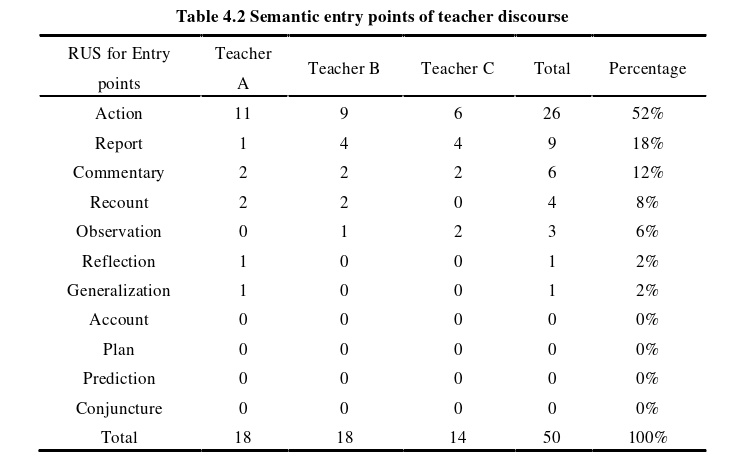
This study adopts Hood’s (2017) segmentation approach, dividing the collected discourse units from reading classes based on PPT slides, with each slide corresponding to a segment of discourse units. It also references Luo Zaibing’s (2019) semantic wave discourse analysis model, analyzing teacher discourse from a static perspective. This static analysis focuses on semantic entry, endpoint, and range, aiming to clarify the positioning of knowledge construction. Given that the teaching style of the same teacher is generally consistent, this section will select classroom discourse from one reading lesson of each teacher for data analysis.
4.2.1 Entry Points
The semantic entry point marks the beginning of each phase of the semantic wave, signifying the teacher discourse utilized at the commencement of each power point slide. An appropriately selected semantic entry point facilitates students’ quicker engagement with the classroom material.
Chapter Five CONCLUSIONS
5.1 Major Findings
Based on the theory of semantic waves, this study investigates the classroom discourse of three high school English teachers during their English reading lessons. It analyzes and discusses their discourse from three aspects: the overall distribution of teacher discourse units, both static and dynamic perspectives, and semi-structured teacher interviews. The main research findings are as follows:
Firstly, teacher discourse encompasses all 11 levels of discourse units, with high semantic gravity and low semantic density units, such as “Commentary” and “Action,” being the most frequent. This indicates that teachers tend to use everyday language and specific examples to facilitate student understanding and knowledge construction during the “unpacking” process. Uniquely, the “Generalization,” which has low semantic gravity and high semantic density, is also used frequently, which is explained by teachers’ preference to clarify complex sentences and specialized terms in the reading texts directly in Chinese.
Secondly, from a static analysis, the majority of teacher discourse generally exhibits low semantic entry points, low endpoints, and a low range of semantic variation, resulting in a consistent resonance characteristic. This reflects an interpersonal prioritization, aligning language with students cognitive abilities to aid in deconstructing and constructing knowledge. However, some teacher discourse exhibits high semantic range, especially when dealing with complex reading materials, where teachers tend to provide interpretations directly in the mother tongue without detailed explanations in English.

